Skip to content
Kirill Kiryushin
EN

Selected publications

Writing on enterprise AI

Who can change the process? Which decisions can an agent make? When does faster work become a financial return? Selected articles from my work at Amalgama, with short reading notes.

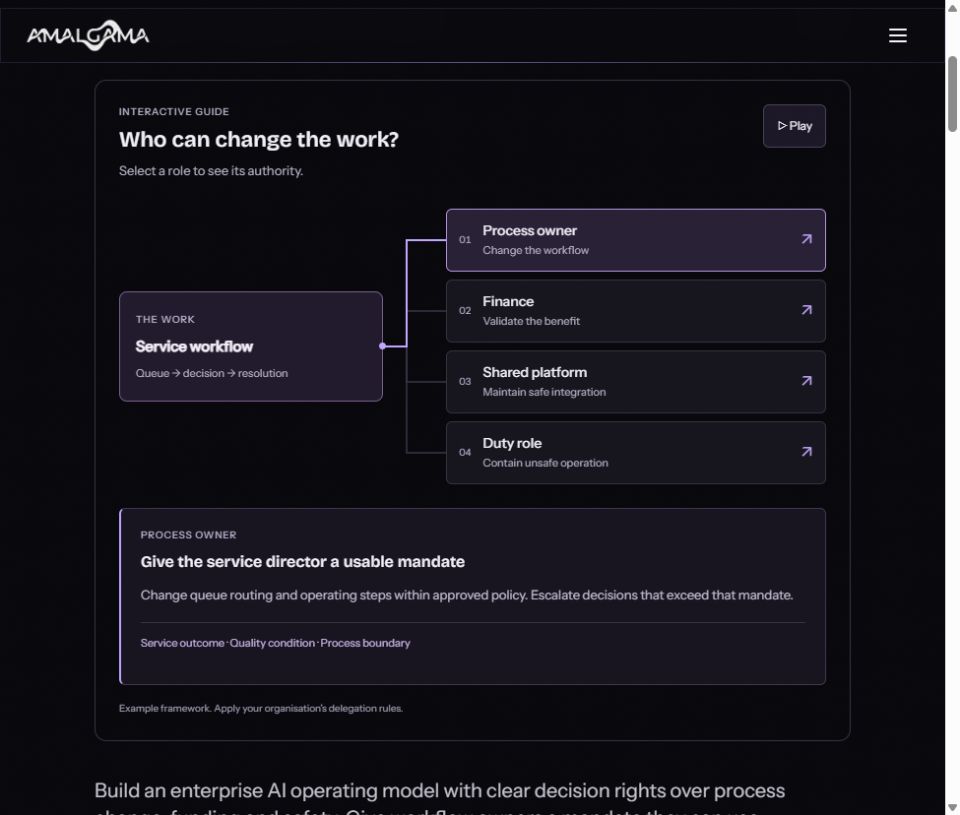
Diagram connecting a live workflow with the process owner, finance, shared platform and duty role
Operating model

Give your AI programme an owner who can change the work

Finance has booked savings. IT owns the project. Operations still controls the approval process. An AI programme can get stuck even when every department has done its assigned work.

The article sets out a usable mandate for the business owner, including process boundaries, resources and the authority to suspend operation. Use it to prepare a portfolio review where expanding, narrowing and ending a project are all possible decisions.

Read the original on Amalgama · EN ↗
Agent governance

AI agent governance for enterprise workflows

A procurement agent can compare quotations and draft an order. Whether it may commit the company to a purchase is a separate decision that needs an explicit owner.

The worked example connects permissions with human approvals, service identities and a tested suspension route. It also asks who receives an exception when the usual reviewer is unavailable. That review workload belongs in the operating budget.

Read the original on Amalgama · EN ↗
AI ROI

Measure enterprise AI ROI before the budget review

Saving time does not tell finance which expenditure will fall. An investment case needs an adoption schedule, the full operating cost and a documented use for released capacity.

This illustrative $12 million operation shows how an apparently attractive productivity gain can produce a negative first-year cash ROI. The numbers are assumptions for a worked example. Use the calculation to challenge double-counted benefits and unrealistic rollout timing.

Read the original on Amalgama · EN ↗